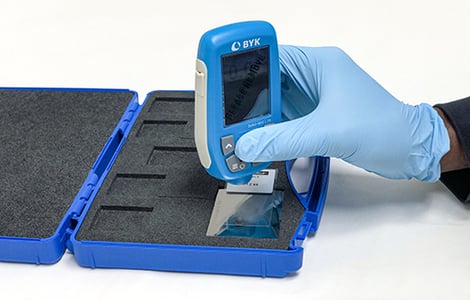
The Importance of Instrument Calibration and Accuracy Verification

Accurate R&D, measurements, and calibrations are essential to delivering the safety and reliability we depend on from paint testing and measuring instruments. In the paint and coatings industry, the two main objectives for calibrating measurement instruments are to verify instrument accuracy and to ensure measurement traceability. Calibration ensures the accuracy and consistency of measuring tools by comparing them against reference standards or calibration equipment and adjusting, as necessary.
What is Calibration?
To calibrate is to check the accuracy, or to adjust or determine, by comparison, the output data of the instrument to be calibrated with the values of a proven, accurate reference instrument or standard. The standard should have an accuracy approximately 10 times that of the measuring device being tested. However, an accuracy ratio of 3:1 is acceptable by most standards organizations. Calibration also includes repairing the device if it is out of calibration. A report is provided that shows the error in measurements with the measuring device before and after calibration. This report will determine whether the measuring instrument is still accurate or needs adjustment. The significance of calibration is that it maintains accuracy, standardization, and repeatability in measurements, assuring reliable benchmarks and results.
A proper calibration:
- Confirms measurement accuracy and repeatability
- Establishes traceability to recognized standards such as NIST
- Documents performance before and after adjustment
- Identifies whether an instrument remains within acceptable tolerances
Calibration certificates provide formal proof of this process, including traceability, uncertainty, environmental conditions, and compliance statements. These records are essential for audits, regulatory compliance, and internal quality systems.
Why are Calibration and Accuracy Verification so Important?
Calibration and accuracy verification are important because they help ensure accurate and consistent measurements, quality, safety, and innovation of most products and services we use and rely on. The accuracy of all measuring devices degrades over time, typically due to normal use. Changes in accuracy can also be caused by drift in humidity or temperature devices, electric or mechanical shock, or hazardous manufacturing environments. To be confident in the results being measured, equipment calibration needs to be maintained throughout its lifetime for reliable, accurate, and repeatable measurements. The reference equipment should itself be directly traceable to equipment calibrated in accordance with ISO/IEC 17025.
Effective calibration delivers:
- Confidence in measurement accuracy
- Compliance with ISO and regulatory requirements
- Reduced risk of costly errors or product recalls
- Improved production efficiency and equipment lifespan
- Greater consistency across multiple instruments and locations
In short, calibration protects both product integrity and business performance.
Traceability—Connecting Your Measurements to National Standards
One of the most powerful outcomes of calibration is traceability. Traceability is a documented, unbroken chain of comparisons that links your instrument’s readings to national or international standards, such as those maintained by NIST. In practical terms, it allows you to demonstrate that your measurements are not just internally consistent, but comparable across labs, facilities, and even countries.
To achieve a truly traceable measurement, three elements must be in place:
- A clear, recognized definition of how the quantity is to be measured
- A calibrated instrument whose performance is documented
- Competent personnel who understand and correctly apply the method
The goal is to minimize measurement uncertainty by ensuring the accuracy of the test equipment and traceability to a national standard. Calibration quantifies and controls uncertainties within measurement processes to an acceptable level. The bottom line is that calibration with traceability improves the accuracy of the measuring device. Accurate measuring devices then improve product quality. Traceability turns individual test results into reliable benchmarks that support audits, certifications, and customer requirements.
Benefits of Calibrating Testing and Measurement Instruments
For many organizations, calibration is viewed as a cost center, but the hidden costs of not calibrating are far higher. Uncalibrated or poorly calibrated instruments can lead to false acceptance of non conforming products, false rejection of good batches, unnecessary rework, and production downtime. Over time, these issues have been translated into increased operating costs, delayed deliveries, and erosion of customer trust.
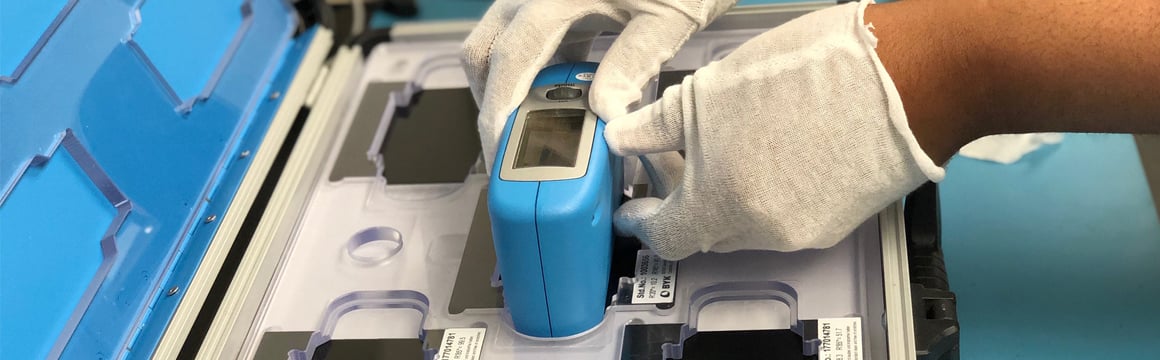
Disciplined calibration delivers tangible benefits such as:
- Calibration reduces costly errors and builds confidence in both the measurement and the measuring instrument.
- Calibration maintains compliance and consistency. Measurement equipment is subject to regulatory compliance. Using equipment that does not meet these standards can incur fines. Also, if you are using multiple measuring tools, they must be consistent with each other.
- Calibration increases production efficiency. Calibration ensures that testing and measurement devices measure accurately and properly detect potential manufacturing problems. Problems can be corrected during normal maintenance times rather than waiting for failures that cause production shutdowns.
- Calibration extends the life of the equipment and delivers return on investment (ROI). Over time, rotating parts can become imbalanced and misaligned. If not discovered quickly by a calibration test, the parts can fail unexpectedly. An inexpensive tune-up can avoid costly replacement and deliver a high ROI.
- Calibration helps organizations comply with government regulations and improve safety. Calibration is necessary to provide confidence for compliance with governmental regulatory bodies. Safety can be improved through precise environmental measurements, confirmed through calibration, which help maintain a proper environment for certain processes, especially those that are hypersensitive.
- Calibration keeps your customer satisfied by delivering what you promise - accurate, consistent measurements that are essential for profitability.
When Should you Calibrate your Measurement Instrument?
To understand the proper calibration schedule, always refer to the manufacturer’s recommendations in the instruction manual. You will also need to calibrate or recalibrate the instrument when required by government regulations or after any electrical or mechanical shock. One factor to consider when choosing a calibration schedule is the cost and consequences of calibration failure, such as product recalls or invalid test results. The calibration schedule must be a feasible, practicable plan that weighs the costs and risks. If the chosen interval is not practical, it will lead to non-compliance. A good balance needs to be established between the costs of a practical calibration plan versus the costs and repercussions of not calibrating often enough.
The hidden costs associated with uncalibrated equipment are often much higher than the cost of calibration. Therefore, the recommendation is to have measuring instruments regularly calibrated by a reputable company to ensure errors in the measurements are within the acceptable range. After a number of calibrations, depending on the measured deviation and the stability of the measuring instrument, you can adjust the interval step by step.
Factors to consider when determining an instrument calibration schedule:
- Importance of the role of the instrument
- Manufacturer recommendations
- Frequency of use
- Frequency of instrument transportation
- Instrument drift
- Testing environment, accidental drop/shock
- Deviation and stability of the instrument
- Impact of the instrument being out of spec
- Risk analysis
Create an Effective Calibration Plan
Every effective calibration program starts with a clear, written plan that fits within your quality system. A robust plan should define:
- Why you calibrate - Internal quality requirements, customer expectations, regulatory or contractual obligations.
- Which calibration method to use - For critical instruments, ISO/IEC 17025 accredited calibration is widely regarded as the most rigorous and defensible option, especially when traceability and detailed documentation are required. Data calibration or standard calibration may be suitable where accreditation is not mandatory or risk is lower.
- Who will perform calibration - Whether you rely on an accredited lab, an internal lab, or a trusted service partner, you should specify competency requirements for technicians and ensure that reference standards are themselves traceable and up to date.
- What reference standards and points are used - Define the standards, ranges, and reference points relevant to your application so calibration reflects actual operating conditions.
- How often each instrument is calibrated - Assign intervals based on criticality and performance history.
This level of planning turns calibration into a controlled, predictable part of your quality infrastructure instead of an occasional, reactive task.
How Do I Calibrate My Measurement Instrument?
First, you need an understanding of your choices of different methods of calibration:
Calibration Methods:
- ISO 17025 Accredited Calibration – The most popular and accurate method for required instrument calibration is having an ISO/IEC 17025 accredited calibration lab perform the service, assuring that all reference instruments and standards are up to date. This is the most rigid form of calibration and requires a maintained account of measurement details. The International Organization for Standardization is a quality benchmark that demonstrates the company has maintained its standards and regulations.
- Requirements:
- Maintaining a mandatory record of details - prior to and after calibration
- Updated list of accessible instruments – ISO certifications are rejected if an instrument is on the list but not physically accessible.
- Continual documentation inspection - Regular inspection of the calibration process is mandatory. Slight changes can be easily detected if the calibration process is closely monitored consistently.
- Quality Module - a component for the organization and implementation of quality management and quality assurance processes in a company. It is used in all phases and operational processes.
- Data Calibration – This method is similar to accredited calibration without being accredited to the ISO standard and requiring no supplemental data
- Standard Calibration – Method used for instruments not critical to quality or that do not require accreditation. To ensure the standards are operational, it is necessary to document the process.
Then you need an understanding of the necessary calibration procedures common to all methods.
Calibration Procedures:
- Measurements are taken from both the reference standard or instrument and the instrument being evaluated. (A series of three measurements is common).
- The values are then compared.
- Plot the data to form the calibration line or curve.
- Examine the calibration curve.
- If the measurements from the instruments are parallel to the standard, then it is considered a proper calibration. Otherwise, the readings will have to be taken multiple times.
What is the Purpose of a Calibration Certificate and What Does it Include?
A calibration certificate is the official document registered for the calibration of the instrument and provides traceability to the National Institute of Standards and Technology (NIST). The calibration certificate reflects the validity and credibility of the calibration organization as well as the accuracy of the instrument’s measurements.
All valid calibration certificates must include the following minimum information:
- A valid accreditation endorsement logo for the calibrations performed. As an alternative, the calibration certificate must contain the following four elements on the first page of the calibration certificate:
- A statement that the calibration meets the requirements
- Name of the accreditation body in which the calibration laboratory is accredited
- Accreditation certificate number
- A statement that the calibration is within the scope of the accreditation
- A title
- Name and address of the accreditation laboratory and location where calibration was performed, if different
- Unique identification number of the certificate and all-inclusive pages with a specified end
- Customer name and address
- Method of calibration used
- Identifiable description of the instrument and its condition
- If critical, the date of receipt of the item to be evaluated, and the dates the calibration was performed
- Reference to the sampling plan and the procedures used
- Calibration results with the units of measurement
- Identification of the name, function, and signature of the individual authorizing the calibration certificate
- A statement that the results refer only to calibrated articles if warranted
- Conditions under which calibrations are performed under if they affect the results.
- Declaration of compliance or measurement uncertainty
- Evidence that the measurements are traceable to NIST
What Should I do if My Instrument Fails Calibration?
When dealing with an out-of-tolerance instrument, be sure to review the calibration certificate to determine what failed. A commercial calibration provider determines the allowable tolerances, or test limits, for the calibration process from the Original Equipment Manufacturers’ (OEM) published specifications unless otherwise agreed upon. A customer can request their equipment to be calibrated against any specification they provide. The specifications can then be agreed on, test limits calculated and compared to determine a statement of compliance.
If you are not confident that your instrument can pass calibration or be brought up to specification, you first need to remove it promptly from production, quarantine it for further adjustments and calibrations, and further assess the situation. The instrument might need to be recalled, reinspected, repaired, or reworked. You then need to ask how much product that was flagged as invalid was sent to inventory or shipped to the customer. Products in the warehouse must be pulled and retested or reinspected, and if the product has already been shipped, the standard requires that you have a process for recalling it.
Handling of non-compliant or out-of-calibration equipment should be a planned, documented process, preferably in the same Control of Nonconforming procedure or a similar procedure already required by ISO 9001.
When an instrument falls out of tolerance, immediate action is required:
- Remove it from service
- Review calibration data to understand the deviation
- Assess impact on previously tested products
- Retest, recall, or rework affected materials if necessary
A documented nonconformance process—aligned with ISO 9001—ensures issues are handled consistently and transparently.
What are the Costs and Risks of Not Calibrating?
The costs of not calibrating include increased production costs due to manufacturing errors and downtime, false acceptance of non-compliant products, false rejection of compliant products, premature failure of manufacturing equipment, faulty R&D, and loss of customer confidence and satisfaction.
Negative Consequences of Uncalibrated Equipment:
- Inaccurate measurements lead to false test results, affecting all aspects of paint and coatings testing
- Parts and Test Rejection — Improperly calibrated machinery results in wasted materials from quality control rejections of inaccurate parts or false test results
- Cost and time overruns — High numbers of rejected parts will require either additional production to replace them or additional finishing processes to bring them up to spec. This extra time will add process costs that cannot be passed on to the customer
- Product liability – accurate measurements are the foundation of product safety
- Reputation damage — Unhappy customers may leave negative online reviews about your services, putting your brand and your pipeline of new customers at risk
Paint testing and manufacturing equipment must be properly calibrated to ensure quality, safety, and performance in accordance with specifications. Calibration helps increase profitability and ROI by reducing costs, improving production efficiency, and extending equipment life. The most popular and accurate method for required instrument calibration is to have an ISO/IEC 17025-accredited calibration lab perform the service, ensuring that all reference instruments and standards are up to date. Without properly calibrated equipment, it is impossible to meet the accuracy requirements of ISO quality standards. Calibration improves the assurance of precise measurements required in research, development, and innovation, as well as the quality of millions of products and services worldwide.