Challenges with Traditional Depth Measurement Tools
Surface damage measurement tools are used for critical maintenance across industries. While traditional tools like ball scribes, pit gauges, and probes are industry favorites for measuring the depth of cavities, craters, pits, and other depressions on a surface, they are considered unreliable and carry a real risk of providing misleading results. These gauges have significant limitations that can affect the accuracy of damage assessment.
Challenges of traditional depth gauges

- Reliable Measurements: Traditional depth gauges depend on a probe making physical contact with the lowest point of the damage. If geometry prevents the probe from reaching the bottom, the resulting measurement will be false. This leads to improper (and potentially unsafe) damage assessments.
- Repeatable Inspections: Depth gauges are difficult to hold still, especially at an angle. When compared to the Optical Micrometer, repeatability is poor on anything other than a flat surface.
- Reduced Risk: Seeing the damage can reveal a more serious problem, such as exposed substrate material or a structural crack.
- Quick and Clear Results: A vernier scale is hard to read and requires manual depth calculations. The zero feature and digital display of the Optical Micrometer eliminate human errors due to misreading the scale and incorrect math.
Specifically, these contact-type instruments struggle to deliver reliable measurements on curved or uneven surfaces and in holes where geometry prevents the probe from reaching the actual bottom of the damage. Its also challenging to hold the pit gauge still and maintain the same angle, resulting in poor repeatability on anything other than a flat, smooth surface. This difficulty can lead to false readings, poor repeatability, and ultimately, costly errors, causing repairable parts to be scrapped or the return of damaged parts to service.
Gage R&R: Repeatability and Reproducibility Case Study
A recent independent study conducted by Singer Laboratories, an independent ISO/IEC 17025 testing lab, compared the repeatability and reproducibility (Gage R&R) of optical versus traditional pit depth gauges. The study found that pit gauges performed poorly on curved or uneven surfaces and in holes, where their probes could not reach the lowest point. The measurements were often shallow, misrepresenting the actual extent of the damage. However, the Optical Micrometer accurately measured more severe damage and revealed hidden issues, making it a more precise tool for proper surface inspection.
Optical Micrometers
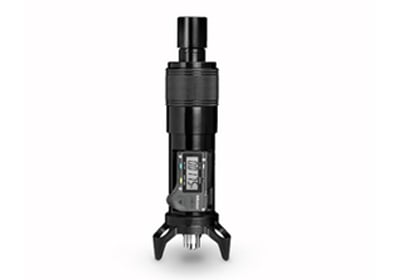
Unlike pit gauges, the Optical Micrometer offers a non-contact method for measuring the depth of scratches, pits, and gouges. Visually inspecting and quantifying damage eliminates the guesswork and risk of hidden structural issues, such as exposed substrates or cracks that may have originated elsewhere. The instrument’s visual confirmation adds a crucial safety layer to damage assessment, reducing the chances of both false positives and negatives compared to physical probes.

Eliminating guesswork from the “repair or replace” decision process saves resources by identifying parts that can be safely repaired and returned to service, thereby avoiding unnecessary replacement costs.
When measuring overall thickness (only), the result initially displayed is not accurate using the Optical Micrometer. To calculate the overall thickness, multiply the initial result by the refraction index. A normal refraction index for transparent materials is approximately 1.5:
- PMMA (acrylic, Lucite) 1.49
- Plate/Window Glass 1.52
- Polycarbonate (Lexan) 1.58
- Tables of refraction indexes of other materials are readily available online.
Application Focus
- Leading Edges: The leading edge is the front section of a wing, propeller, turbine blade, stabilizer, or other airfoil. During a flight, the leading edge is repeatedly hit by debris such as sand, pebbles, ice, insects, and even birds. This always results in strike damage and long-term erosion. The curved shape of a leading edge makes it almost impossible to take measurements with a pit depth gauge. The V-Block Base holds the Optical Micrometer steady on a curve, so it is ideal for measurements on a leading edge. It can measure the depth of a pit in seconds, whereas a pit depth gauge can’t produce a result at all, or worse, gives a faulty one. Especially when the type of damage is so common, it is an expensive problem when maintainers don’t have an inspection method that’s fast, reliable, and repeatable.
- Transparent Surfaces: Windshields, windows and canopies are subject to extreme conditions from atmospheric pressure, changes in temperature, UV radiation, erosion and other impact damage. Left unrepaired, seemingly small problems like crazing and scratches can quickly lead to an expensive replacement or, much worse, failure.
- Blending, Blasting and Polishing: In most cases, minor surface damage doesn’t affect an aircraft’s performance or safety and can be repaired. The most common method is to smooth the harsh edges of a damaged area to reduce stress concentrations and prevent further corrosion or cracking. Blending, blasting, polishing, and peening differ in application, but are similar in that they all remove material and leave a recessed area in the surface. This means that the overall thickness of the surface is reduced by (at least) the depth of the original damage. If a scratch is deep enough to exceed the overall thickness limits, it will still exceed those limits after the repair. There’s no point wasting time on damage that’s beyond limits. If a part needs replacing, it’s best to know right away to reduce downtime.
Real-World Impact
- Aircraft Maintenance: The Los Angeles County Fire Department (LACFD) relies on the Optical Micrometer for surface inspection on its fleet of helicopters. By implementing on-the-spot measurements, the department has shown savings on parts, time, and workflow. This action has led to substantial cost savings and minimized aircraft downtime.
- Industrial Applications: At Boeing’s St. Louis plant, engineers used the micrometer to correctly identify damage outside allowable limits on a hydraulic tube, spotting a hidden pit that would have gone unnoticed with a pit gauge. At Fort Eustis, inspectors saved a $10,000 shaft from being scrapped unnecessarily. and at Springfield’s Air National Guard, the micrometer revealed a critical crack in a tail rotor yoke that other methods had missed.
Maintenance Efficiency and Cost Savings
By enabling accurate, repeatable measurements and visual verification, optical micrometers safeguard repair shops and operators against insufficient data and reduce unnecessary part replacements. Their adoption enhances inspection workflow, improves aircraft serviceability, and delivers measurable return on investment, even from a single use.
Modern inspection demands tools that match the complexity and value of today’s equipment. Optical micrometers stand out for their reliability, precision, and cost-saving potential, enabling maintenance crews to assess damage and protect people and valuable resources with confidence.