A Comprehensive Guide to Viscosity Measurement
Principles, Instrumentation, and Best Practices for Coatings, Adhesives, and Formulated Products
Viscosity is a fundamental physical property that influences how liquids flow, spread, and level under applied conditions. It is defined as a fluid’s internal resistance to flow. The ability to measure it accurately allows manufacturers to predict how a formulated product will behave in a process or an application. For example, in applications such as rolling or brushing, the viscosity of a paint strongly influences the amount of material applied per unit of surface area, which determines both coverage and hiding power. Because of the link between viscosity and finished-product performance, viscosity measurement is a standard requirement for incoming raw material inspection and outgoing quality control for liquid products across the coatings, adhesives, personal care, food, and industrial chemical sectors.
This white paper presents a technical overview of viscosity measurement: the terminology used to describe it, the parameters that influence a measurement, the instrumentation available to quality control and research laboratories, and the standards that govern testing across industries. It is intended as a reference for quality control personnel, formulators, and process engineers who need to select an appropriate measurement method, interpret results with confidence, and maintain a reliable calibration and verification program.

Table of Contents
- Defining Viscosity
- Viscosity Measurement Fundamentals
- Rheology: Understanding Fluid Behavior
- Achieving Accurate Measurements With a Rotational Viscometer
- Selecting the Correct Viscometer Range and Spindle
- Interpreting Viscosity Flow Curves
- Measurement Methods and the Influence of Shear Rate
- Viscometers for Specialized Applications
- Verification and Calibration of Viscometers
- Viscosity Terminology and Related Standards
1. Defining Viscosity
The term "viscosity" is used loosely in everyday quality control conversations, but it refers to several distinct physical quantities depending on the type of fluid and the measurement method used. Clarifying which viscosity value is being reported is the necessary first step before any measurement program is designed.
Kinematic Viscosity, represented by the Greek letter nu (ν), is established from a flow-time measurement and takes into account the effect of gravity on the fluid. It applies primarily to less viscous fluids that exhibit simple, Newtonian rheological behavior and is expressed in stokes, centistokes, or square centimeters per second. Kinematic viscosity is the ratio of absolute (or dynamic) viscosity to density. It can be obtained by dividing the absolute viscosity of a fluid by the fluid mass density (ν = μ / ρ), where ν = kinematic viscosity (m2/s), μ = absolute or dynamic viscosity (N s/m2), and ρ = density (kg/m3). If using Stokes, 1 St (Stokes) = 10-4 m2/s = 1 cm2/s.
Dynamic Viscosity, represented by the Greek letter eta (η), quantifies the force required to make a fluid flow at a certain rate. This measurement represents the internal friction between adjacent layers of a fluid moving relative to one another. Liquids resist this shearing motion due to cohesive forces, while gases resist it due to results from the exchange of momentum between molecules. Dynamic viscosity is independent of fluid density and is most commonly measured with rotational instruments. Because it accounts for the rheological behavior of the product, dynamic viscosity has an absolute character that kinematic viscosity does not. It is expressed in pascal-seconds, millipascal-seconds — where 1 mPa·s equals the viscosity of water at 20°C — or in poise and centipoise.
In polymer science, additional viscosity values, such as specific, intrinsic, and relative viscosities, are used to calculate the average molar mass of polymers in solution. Before undertaking any viscosity measurement, it is important to define precisely what information the measurement is intended to provide, since selecting the wrong viscosity value for the application can produce results that are difficult to interpret or unnecessary for the intended purpose.
Determining the Relevance of a Viscosity Measurement
Confirming that a planned viscosity measurement will produce useful, actionable data requires answering several preliminary questions. The purpose of the measurement should be established first: whether the goal is to meet an industry standard, verify the stability of product quality, validate an industrial process, support product innovation, or provide a specification to a customer.
The temperature at which the measurement is taken should reflect the conditions the product experiences during the phase of its life cycle being characterized, since viscosity is temperature-dependent, and results measured under unrepresentative conditions will not correlate with real-world performance. The precision of the measurement method should also be evaluated against the magnitude of the differences to be distinguished between two products or batches; a highly precise instrument is of limited value if it cannot resolve the discrepancies that matter for quality decisions.
Communicating the standard used and the exact measurement conditions is essential to productive dialogue between internal departments, customers, and suppliers. A frequent and legitimate source of confusion arises when two organizations report different viscosity values for what should be the same product. This discrepancy typically originates in differences in measurement conditions rather than in the product itself and is addressed in detail in the discussion of rheology in Section 3. The more information that accompanies a reported viscosity value, instrument type, spindle or geometry, rotational speed, temperature, and measurement duration, the easier it becomes for a second party to reproduce the measurement under comparable conditions. In many cases, industry standards, or product constraints, such as available sample volume, required test temperature, or product type, will dictate the use of a specific instrument or one capable of adapting to a range of stated conditions.
2. Viscosity Measurement Fundamentals
Critical Parameters in Viscosity Measurement
Viscosity is not a fixed physical constant; it varies with several parameters that must be understood and controlled to obtain a reliable quality control measurement. Three factors are of primary importance.
- Temperature: The chemical formulation of a sample determines how strongly temperature affects its viscosity value. Because increasing temperature generally lowers measured viscosity, samples should always be compared at the same temperature or in accordance with the temperature specified in the applicable standard.
- Speed, or shear rate: This is the dominant parameter influencing the viscosity of non-Newtonian formulated products. Reliable measurement of shear-rate-dependent products requires a defined or standardized geometry, such as a cone-and-plate or coaxial-cylinder system, in which the shear rate is precisely known.
- Time: Viscosity in certain products decreases when shearing is sustained over a longer period compared to a short application of shear. This thixotropic effect is relatively rare but can materially affect a manufacturing process and compromise the accuracy of a viscosity control program when it is not properly accounted for.
Viscometer Technology Selection
A range of viscometer designs has been developed over the past century, driven by historical standard methods and by the practical need for instruments that are simple to operate. When multiple technologies are available, several considerations determine which instrument best suits a given sample and application.
- Glass kinematic tube viscometers deliver highly accurate kinematic viscosity values for very fluid samples with simple rheological behavior. They are the standard instruments in the petroleum industry and are also used to analyze solvent-diluted polymer solutions.
- Falling-ball Höppler viscometers, standardized in pharmacopeia viscosity controls, are well suited to Newtonian clear syrups and lotions. A set of balls of different sizes allows a range of viscosities to be measured, and the sample temperature can be controlled through an external circulating water bath.
- Standard flow cups, with a defined volume and a calibrated orifice diameter, are common in the coatings and paints industry. They are easy to use and well adapted to solvent-based paints.
- Rotational viscometers with a standard spindle satisfy ASTM and ISO standard test methods and represent the most widely used system for measuring the relative dynamic viscosity of nearly any product type. Accurate use requires attention to rotational speed, spindle selection, sample volume, and measurement duration.
- Rotational viscometers with defined shear-rate geometries, such as cone-and-plate or coaxial-cylinder systems, comply with DIN and ISO standards and are recommended for non-Newtonian products across all industries. These configurations produce the most well-defined, absolute viscosity values.
Validating Measured Values Against Application Requirements
Beyond compliance with a specific standard, a well-designed viscosity measurement method should be evaluated for its relevance to the application information it is meant to support. When the objective is to confirm that a sample is suitable for a customer’s process, viscosity should be measured at the shear rate that corresponds to the actual application step.
A related objective is evaluating a product’s stability over time or its compatibility with a new packaging format or process line. Depending on the application, it may be worthwhile to design a specific measurement method optimized for the quality characteristics that matter most for that product. Straightforward shear-rate calculation formulas, combined with a working knowledge of the processing, storage, and packaging conditions a product will experience, are valuable tools for correlating measured results with real-world application performance.
3. Rheology: Understanding Fluid Behavior
The Relationship Between Rheology and Viscosity
Viscosity and rheology are closely related but are distinct concepts. Viscosity is the fundamental unit of measurement used throughout rheological studies of a product, and it is therefore intrinsically linked to a product’s rheological behavior. Rheology, the science of flow, provides the framework for understanding how a fluid behaves under the range of conditions it encounters during manufacture, packaging, storage, transport, and end use.
The key parameters that influence viscosity and are studied in rheology are temperature, deformation or shear, and time.
Newtonian products are fluids whose viscosity varies only with temperature. Water, oils, solvents, honey, varnishes, and conventional glycerophthalic paints fall into this category, and a single viscosity measurement at a defined temperature is sufficient to characterize them.
Most formulated products, by contrast, become more fluid than at rest when deformed or sheared. These are described as shear-thinning products, and they fall into two principal groups: Pseudoplastic fluids flow by gravity once shear is applied, including products such as shampoos and emulsions.
Plastic products require a threshold stress to be exceeded before flow begins; familiar examples include ketchup, toothpaste, paint, and chocolate.
Additional rheological characteristics, such as visco-elasticity, are relevant when evaluating product stability, holding properties, or adhesive performance. As noted above, time can also affect viscosity through thixotropy, a reversible drop in viscosity as a function of shearing duration. This behavior compounds the effects of shear-thinning and, because it is often difficult to control, it can lead to product quality deviations and process complications if it is not properly characterized.
Instrument Selection for Rheological Analysis
Fully characterizing rheological behavior requires instruments and software suited to the complexity of the measurement. Sophisticated, high-cost solutions are often recommended by default, but they are not always the most practical choice for a given quality control or research application. A pragmatic approach considers several questions specific to the product being analyzed: the sample volume available, the approximate order of magnitude of the viscosity, the physical nature of the product, whether it contains particulate loading, the level of expertise required (quality control, research and development, or fundamental research), the available budget, and whether in-house personnel have the skills needed to operate the equipment and interpret the resulting data. The answers to these questions guide the selection of instrumentation, accessories, and methodology best suited to the application.
The OICCC standard for chocolate viscosity, established in the 1970s, illustrates the enduring value of a well-designed rheological method, It defines measurement of chocolate viscosity at 40°C together with determination of the flow limit according to the Casson model, producing two parameters that continue to characterize chocolate structure today: a value derived from cocoa butter content, and the shear viscosity once the sample exceeds its yield point.[2] This simple, comprehensive method of rheological control demonstrates that rheology is present in every formulated product and can address quality, pumping, stability, and application challenges without requiring an overly complex measurement protocol.
4. Achieving Accurate Measurements With a Rotational Viscometer
Rotational viscometers offer a cost-efficient, reliable, and reproducible method for measuring the viscosity of liquid samples. When fitted with an accessory such as a small sample adaptor, they can measure absolute viscosity because the accessory provides a defined shear rate from which absolute values can be calculated. In many quality control applications, however, a relative viscosity measurement is sufficient: the spindle is inserted directly into a beaker or production container, producing a value that can be compared against a specification defined for those same conditions or against previous batches to confirm consistent product quality.
The following procedure describes the steps required to obtain accurate, repeatable results with a rotational viscometer.
- Confirm that the viscometer is properly calibrated using an ISO 17025 certified calibration oil.
- Prepare the sample in accordance with a recognized standard test method, such as ASTM D2196, Standard Test Methods for Rheological Properties of Non-Newtonian Materials by Rotational Viscometer, or ISO 2555 and ISO 1652.[1]
- Use the same viscometer, spindle, rotational speed, test duration, container shape and size, container placement, and sample size for every repetitive or quality control test to ensure repeatable and reliable results. Always use the spindle guard leg.
- Control both the ambient temperature and the temperature of the sample, spindle, and spindle guard, since viscosity is temperature-dependent. A circulating water bath and related accessories can maintain the required temperature. Allow the system to equilibrate for at least one hour before measuring and use a sample temperature probe during measurement to confirm that sample temperature remains constant.
- Confirm that the spindle is clean, that the shaft is not bent, and that it is free of dings or dents.
- Avoid introducing air bubbles into the sample during preparation.
- Avoid shearing the sample through shaking, stirring, or mixing during preparation, since shear-thinning and shear-thickening materials require time to recover their resting viscosity. Always lower the spindle slowly into the sample, and if shear is unavoidably introduced, allow sufficient recovery time before measuring.
- Confirm that the sample container is clean and free of residue from prior tests.
- Immerse the spindle in the sample to the midpoint of the line marked on the shaft. Overfilling or underfilling the container can produce erroneous results.
- Avoid turbulence, which is normally caused by higher rotational speeds and can distort results, particularly with lower-viscosity samples.
- Use a consistent test duration for every measurement, since many fluids change viscosity over time; shear-thinning fluids, for example, decrease in viscosity as shear is applied, and this reduction can itself be time dependent.
- In most cases, allow the spindle to complete at least five rotations before recording a value, adjusting as needed for non-Newtonian fluids. Measurement time should not be excessive, particularly with highly viscous samples, since prolonged rotation can generate friction and shear heating that alters viscosity. As a general rule, allow the displayed viscosity to stabilize before recording a measurement; if it does not stabilize, the fluid likely exhibits time-dependent viscosity, and a defined measurement time or times should be established.
- Prevent the sample from drying or evaporating during handling, since evaporation will increase the measured viscosity.
5. Selecting the Correct Viscometer Range and Spindle
Rotational viscometers are manufactured in three viscosity ranges — low, medium, and high — to accommodate the broad spectrum of products encountered across industries.
The first step in method development is identifying which of these ranges best approximates the viscosity of the product being measured.
Table 1 lists representative product categories for each range.
| Low viscosity | Medium viscosity | High viscosity |
|---|---|---|
| Adhesives (solvent base) | Adhesives (hot melt) | Asphalt |
| Biological fluids | Ceramic slurries | Caulking compounds |
| Chemicals | Creams | Chocolate |
| Coatings, water-based | Dairy products | Epoxies |
| Edible oils | Detergents | Gels |
| Inks, water-based | Dressings and sauces | Grease |
| Juices | Gums | Inks (ballpoint, offset) |
| Liquid soap | Inks (screen printing) | Mayonnaise |
| Liquid wax | Lotions and creams | Molasses |
| Mouthwash | Paints | Ointments |
| Paints, latex | Paints and coatings | Pastes |
| Photo resist | Paper coatings and pulp | Peanut butter |
| Soda | Plastisols | Putty |
| Solvents | Shampoo and conditioner | Roofing compounds |
Table 1. Representative product categories by relative viscosity range.
Once the appropriate viscometer range has been identified, the second step is selecting a spindle and rotational speed. Each viscometer is supplied with a set of spindles that together cover its full viscosity range, and in practice, identifying the correct spindle and speed combination generally requires some trial and error.
Several factors should be considered before finalizing a spindle and speed selection.
- When duplicating an established method or a previously reported result, use the same spindle, rotational speed, container, and sample size specified in that method.
- When approximating a particular application shear rate, such as the shear generated during product application, select a rotational speed that approximates that shear rate.
- When the approximate viscosity of the sample is already known, use the corresponding setting on the viscometer. Entering a spindle code and rpm setting will display the viscosity range covered by that combination, allowing several combinations to be evaluated before selecting the most appropriate one.
- When the viscosity of the sample is unknown, the goal is to find a speed and spindle combination that produces a torque reading between 20 percent and 90 percent full scale, with 50 percent representing the optimal accuracy target. If varying the speed does not produce a reading in this range, a different spindle should be tried: a reading above 90 percent at the slowest speed calls for the next smaller spindle, and a reading below 20 percent at the highest speed calls for the next larger spindle.
- When testing at multiple speeds is required, select a spindle that yields readings between 20 percent and 90 percent for at least three speed settings.
As a general principle, the lowest viscosity range is best measured with the largest spindle operating at maximum speed, while the highest viscosity range is best measured with the smallest spindle operating at the lowest speed.
6. Interpreting Viscosity Flow Curves
Steady-shear flow curves generated for suspensions and solutions under identical measurement conditions can exhibit markedly different behavior across a range of shear rates, and some materials display more than one distinct behavior within different shear-rate regions of the same flow curve. Figure 1 illustrates the flow-curve classifications most frequently encountered in coatings, adhesives, and formulated-product testing.

Figure 1. Classification of steady-shear flow curves by shear stress versus shear rate relationship.
Newtonian fluids exhibit constant differential viscosity and a constant viscosity coefficient regardless of shear rate. Shear-thickening fluids show differential viscosity and viscosity coefficient that increase continuously with shear rate. Shear-thinning (pseudoplastic) fluids without a yield value show differential viscosity and viscosity coefficient that decrease continuously with shear rate. Shear-thinning(pseudoplastic) fluids with a yield response behave the same way once the apparent yield stress has been exceeded.
An ideal Bingham plastic obeys the Bingham relation precisely: above the Bingham yield stress, differential viscosity remains constant, a value referred to as plastic viscosity, while the viscosity coefficient decreases continuously toward a limiting value at infinite shear rate. A non-ideal Bingham plastic shows a viscosity coefficient that decreases continuously above the apparent yield stress, while differential viscosity approaches a constant value as shear rate increases. Extrapolating the linear, high-shear-rate portion of the flow curve back to the stress axis yields the apparent Bingham yield stress, and the differential viscosity within that linear region is termed the plastic viscosity.
7. Measurement Methods and the Influence of Shear Rate
Most paints are non-Newtonian liquids, meaning that their viscosity depends on the shear rate applied during measurement or use. Many paints exhibit lower viscosity under the high shear rates generated by stirring or spraying than at their storage, or resting viscosity. Because different viscosity measurement methods use different shear rates, the same non-Newtonian paint can yield different measured viscosities depending on the method used. In some cases, the time dependence of viscosity following shear must also be considered: the measured viscosity of a thixotropic paint depends on how the paint was handled before measurement, since the material retains a memory of prior shear treatment for a period of time.
For these reasons, selecting a method that applies a reproducible shear rate is essential to a meaningful paint quality check. Figure 2 presents representative shear rates associated with common applications and with the principal measurement methods used to evaluate them.

Figure 2. Representative shear rates for coating application processes and viscosity measurement methods.
Rheometers
Rheometers are the instrument of choice for studying the complete rheological profile of a material. While they provide the most comprehensive picture of fluid behavior, they are complex to operate, require highly trained personnel to interpret the resulting data, and represent the highest capital investment among viscosity instrumentation.
Rotational Viscometers
- Rotational viscometers are straightforward to operate and are the most commonly used instruments for quality control applications. Like rheometers, they produce repeatable and reliable results, and different configurations operate at shear rates suited to specific applications.
- Basic Rotational viscometers are highly versatile, covering a broad range of shear rates and viscosities. They provide a reliable, reproducible method for measuring relative viscosity directly in cans and beakers as a straightforward quality control check, and can also determine absolute viscosity across a wide range when fitted with a small sample adaptor.
- Krebs or Stormer viscometers are best suited to paints that will be applied by brush or roller, corresponding to a medium shear rate range of 10 to 100 reciprocal seconds. Architectural paint is the most common application, though this viscometer type is also used wherever a fast, reliable, and highly standardized method is required.
- Cone-and-plate viscometers are typically used at high shear rates, allowing control over a paint’s viscosity during application, though they can also measure at shear rates as low as 20 reciprocal seconds. Samples are tested in a precisely defined geometry, and these instruments can measure absolute viscosities up to 15,000 poise.
Flow Cups
Flow cups are a low-cost option that provides a quick viscosity check. The primary result obtained is the efflux time, which can be converted to kinematic viscosity. Because flow cups are prone to error when used with thixotropic paints — the measured value for such products can depend heavily on handling before measurement, including stirring and the manner of filling the cup — they should be reserved for Newtonian liquids.
See the Insta-Visc Viscosity Calculator App to help calculate the viscosity from measurements with flow cups. [3]
8. Viscometers for Specialized Applications
Cone and Plate Viscometers
Cone-and-plate viscometers, described in DIN ISO 2884-1 and ASTM D4287, are used to evaluate dynamic viscosity under controlled shear conditions. [4] They serve as a practical tool for any quality control or research and development laboratory requiring quick, straightforward testing of materials regardless of application. These instruments accommodate Newtonian and non-Newtonian materials with viscosities up to 15,000 poise and shear rates ranging from as low as 25 reciprocal seconds to as high as 13,000 reciprocal seconds. Models are available with either fixed speeds that meet industry standards or variable speeds that allow shear rate to be adjusted. Most include built-in heating and cooling to permit testing over a temperature range of 5°C to 235°C.
Cone-and-plate viscometers offer several advantages over a standard rotational viscometer. They apply a uniform shear rate throughout the measurement, unlike a conventional viscometer, in which the shear rate varies across the sample container. Results are independent of container size and shape, it is easier to fill and clean, and fewer samples are required. Temperature ramping and stabilization occur faster, and the instrument can rapidly complete two-point quality control tests in which the specified shear rates are far apart, such as 20 and 9,000 reciprocal seconds. Overall cycle time is faster, reducing the time and labor cost of routine testing, and the broad shear-rate range is sufficient to reveal shear-thinning behavior in pseudoplastic materials.
These advantages are balanced by certain limitations. Cone-and-plate testing requires a highly homogeneous sample because of the small sample volume involved, and materials containing large particles can yield inconsistent results. The instruments are more expensive than a standard rotational viscometer, and correct fill volume beneath the cone is essential; incorrect fill volume can produce large variations in reported viscosity values. The small sample size also dries more quickly during testing, and the achievable shear-rate range, while broad, is more limited than that of a standard rotational viscometer.
Krebs / Stormer Viscometers
The most widely used method for determining the viscosity of architectural paint relies on a Krebs or Stormer viscometer, described in ASTM D562. [5] The Stormer viscometer uses a paddle that rotates through the paint at 200 rpm within a standardized container, and the resistance the paint generates is measured and expressed in Krebs units. A higher Krebs unit value indicates a more viscous paint. Modern instruments, such as the BYK byko-visc DS, simultaneously display viscosity in centipoise and in grams. The BYK instrument covers the 40 to 141 Krebs unit range, equivalent to 27 to 5,274 centipoise per ASTM D562, and produces operator-independent results with no manual calculations required. [5]
Krebs and Stormer viscometers are used routinely in quality control to confirm that paints meet production specifications and in research and development to formulate new coatings.
They are best suited to paints applied by brush or roller, corresponding to a medium shear rate range of 10 to 100 reciprocal seconds, depending on brushing speed and coating depth. They are also used in other contexts, including raw materials, slurries, and select food products within the appropriate viscosity range.
Measurement of Creams, Gels, and Ointments
The application of a cosmetic product to skin is fundamentally a sensory experience in which the flow characteristics of creams, gels, and ointments play a determining role. These same physical properties are equally important to producing a product that packages properly and is easy for the consumer to use. Cosmetic formulations of this type consistently exhibit shear-thinning behavior, meaning viscosity decreases as the applied shear strain increases. Many also display plastic behavior, requiring a threshold stress before flow begins rather than flowing under gravity alone, and some exhibit visco-elastic properties spanning a range from solid-like to liquid-like behavior.
Given this range of flow properties, defining the most appropriate viscosity measurement method is essential to obtaining values that meaningfully characterize product quality and application feel.
Rotational Viscometer
With a Rotational Viscometer, you can apply either a fixed rotational speed, per ISO 2555, or a defined shear rate or shear-rate ramp, per ISO 3219. This approach helps formulators understand the force required to initiate flow, information directly relevant to pump design, and the packaging pressure needed to dispense the product. The force required to initiate flow in a cream or gel is its yield stress; once flow begins, the sample exhibits shear-thinning behavior, in which viscosity decreases under continued shear strain. Using a rotational viscometer to determine the shear-thinning curve at specified shear rates, per ISO 3219, gives formulators a clearer understanding of how the product will flow and feel during application to skin. [6]
Because shear-thinning behavior is the primary characteristic under investigation in these products, environmental conditions significantly affect the measured values. Sample temperature should be measured during testing, or a thermostatic chamber should be used to maintain it. Measurement duration is another important variable: a decrease in viscosity during shearing indicates a thixotropic effect, which should be considered when assessing product stability.
Two standard methods, drawn from ASTM and ISO, govern viscosity testing of these product types.
- ISO 2555 measures apparent viscosity by recording torque with the spindle rotating at a constant speed in a defined 500-milliliter beaker. Apparent viscosity, expressed in centipoise (equivalent to millipascal-seconds), is calculated by multiplying the viscometer scale reading by a scale factor that depends on the spindle number and rotational speed. For non-Newtonian materials, this method provides limited information but is adequate for comparative quality control, provided that all conditions, including stop time, remain consistent between tests.
- ISO 3219 relies on precisely defined shear-rate geometries; premium instruments, such as the byko-visc RT, allow rotational speed and shear rate to be increased or decreased during the test. Shearing the sample across a range of rates makes it possible to analyze flow behavior, determine yield stress, and identify thixotropic effects, providing research and development, quality control, and process personnel a complete and useful picture of product viscosity across all relevant application conditions.
9. Verification and Calibration of Viscometers
Manufacturers of cosmetics, food, paint, pharmaceuticals, personal care, and many other product categories run viscosity tests daily across a large variety of products, spanning research and development, in-process monitoring, and final quality control. The viscosity of the products tested can vary considerably; a food manufacturer, for example, might need to test a thin, low-viscosity salad dressing alongside a higher-viscosity, shear-thinning ketchup.
When a viscometer is used to test substances of varying viscosities, it is important to confirm that the instrument is calibrated across the viscosity range of the products being tested.
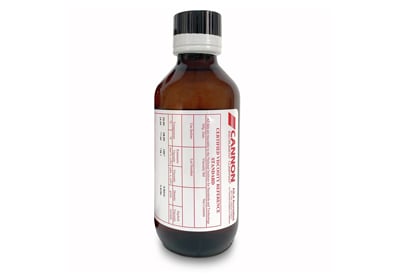
Modern rotational viscometers, such as the BYK byko-visc RT series, allow the user to verify calibration and to calibrate their instrument on site using ISO 17025 [7] certified standard oils.
Because viscosity varies with temperature, calibration oils are certified at specific temperatures listed on the accompanying certificate. Most oils are certified at 25°C, though higher-temperature oils are also available, and some oils carry certification at multiple temperatures.
Both the calibration oil and the spindle should be maintained at the certification temperature during calibration, which can be achieved using a circulating water bath or a comparable temperature-control accessory. To ensure accurate calibration, using two or three oils with different viscosity values is recommended, ideally with one value below and one above the viscosity of the products being tested. BYK standard oils do not change viscosity with time or with applied shear.
Calibration oils relevant to the viscosity of the products being measured should be purchased with every viscometer to ensure accurate readings and to comply with ISO 17025 [7] and other applicable quality systems, standards, and customer requirements. ISO 17025 certified oils are available from GARDCO that cover the entire available viscosity range, making regular calibration simple and inexpensive.
10. Viscosity Terminology and Related Standards
Glossary of Terms
The following definitions clarify the terminology used throughout viscosity and rheology measurement.
| Term | Definition |
|---|---|
| Absolute viscosity | The force needed for a liquid to overcome its internal friction and begin to flow. Also known as dynamic viscosity. |
| Centipoise (cP) | A unit of dynamic viscosity equal to one-hundredth of a poise. |
| Dilatant | A shear-thickening fluid whose viscosity increases as shear rate increases. Fluids containing suspended solids, such as some candy syrups and sand-water mixtures, exhibit this behavior. |
| Dynamic viscosity | Also called shear viscosity, the resistance of one fluid layer to move relative to an adjacent layer, or the force needed to make a fluid flow at a given rate. |
| dyne-cm | A unit of measurement traditionally used to measure surface tension. May also refer to torque in viscosity measurements. |
| Fluid | A substance that deforms continuously under an applied shear stress may be a liquid or a gas. |
| Kinematic viscosity | A fluid's internal resistance to flow under gravitational force, determined by measuring the time required for a fixed volume to pass a known distance through a calibrated orifice at controlled temperature. Zahn cups, Ford cups, and capillary viscometers are typical instruments. |
| Krebs units (KU) | The weight in grams required to turn a paddle-type rotor submerged in a sample 100 revolutions in 30 seconds, typically measured with a Krebs or Stormer viscometer at 200 rpm. Widely used in the paint and coatings industry; convertible to centipoise per ASTM D562. [5] |
| MilliPascal-second (mPa·s) | A dynamic viscosity unit; 1,000 mPa·s equals one pascal-second. |
| Newtonian | A fluid whose viscosity remains constant regardless of applied shear rate. Water is a common example. Measured viscosity for Newtonian fluids does not depend on spindle, speed, or viscometer selection. |
| Non-Newtonian | A fluid whose viscosity changes as shear rate changes, including pseudoplastic, dilatant, plastic, thixotropic, and rheopectic behavior. |
| Plastic | A fluid that behaves as a solid under static conditions and requires a threshold stress, the yield stress, before it begins to flow. Ketchup is a familiar example. |
| Poise (P) | A dynamic viscosity unit in the centimeter-gram-second system; 10 poise equals one pascal-second. |
| Pseudoplastic | A shear-thinning fluid whose viscosity decreases as force is applied. Paint, nail polish, whipped cream, and milk are common examples, and this is the most frequently encountered non-Newtonian behavior. |
| Relative viscosity | The viscosity of a non-Newtonian material measured at a defined shear rate. |
| Reciprocal seconds | Unit of measurement of shear rate. Also written as seconds-1. |
| Rheology | The study of the deformation and flow of materials, with particular emphasis on non-Newtonian fluids. |
| Rheometer | An instrument that measures how a liquid flows in response to varying applied forces; used for fluids with complex viscosity characteristics that cannot be described by a single value. |
| Rheopexy | A rare non-Newtonian behavior in which viscosity increases over time under constant shear. Gypsum paste is a known example. |
| Shear (liquid) | The relative motion between adjacent layers of a moving liquid. Shear forces act tangentially to a surface causing deformation. |
| Shear rate | The rate at which a fluid is sheared during flow, expressed in reciprocal seconds (s⁻¹), and determined from spindle geometry and rotational speed. |
| Shear stress | The force per unit area required to move a material, arising primarily from friction between fluid particles. |
| Static yield | The force or torque required to initiate flow in a material at rest. |
| Stormer viscometer | An instrument defined in ASTM D562 that uses a paddle-type spindle rotating at 200 rpm; the most widely used viscometer for paint and coatings viscosity testing. |
| Stoke (St) | A kinematic viscosity unit: one stoke equals 100 centistokes, or one poise divided by fluid density in g/cm³. |
| Thixotropy | A time-dependent, shear-thinning behavior in which viscosity decreases under constant shear and gradually recovers once shear is removed. Found in gelatins, greases, and heavy printing inks. |
| Torque | The rotational equivalent of linear force, measured in a viscometer as the energy required to rotate the spindle within the sample. Expressed in newton-meters. |
| Viscometer | An instrument used to measure the resistance of a fluid to deformation under shear stress. Rotational viscometers use a spindle moving through the sample; flow-cup viscometers measure the time for a fixed volume to pass through a calibrated orifice. |
| Viscosity | A measure of a fluid's resistance to flow, equal to shear stress divided by shear rate. |
| Yield stress | The force required for a material to begin flowing, such as the force needed to dispense toothpaste from a tube or ketchup from a bottle. |
Table 2: Glossary of Terms
ASTM Standards for Rotational Viscometry
Viscosity measurement is governed by numerous international standards that establish a mutual understanding of test methods and quality expectations between suppliers and buyers. Table 3 summarizes representative ASTM test methods relevant to viscosity measurement across industries.
| Standard | Title |
|---|---|
| C474 | Standard Test Methods for Joint Treatment Materials for Gypsum Board Construction |
| C965 | Practices for Measuring Viscosity of Glass Above the Softening Point |
| C1276 | Standard Test Method for Measuring the Viscosity of Mold Powders Above Their Melting Point Using a Rotational Viscometer |
| D115 | Methods of Testing Varnishes Used for Electrical Insulation |
| D562 | Standard Test Method for Consistency of Paints Using the Stormer Viscometer |
| D789 | Test Methods for Determination of Relative Viscosity, Melting Point, and Moisture Content of Polyamide (PA) |
| D803 | Standard Test Methods for Testing Tall Oil |
| D1074 | Test Method for Compressive Strength of Bituminous Mixtures |
| D1076 | Specification for Rubber-Concentrated, Ammonia Preserved, Creamed and Centrifuged Natural Latex |
| D1084 | Test Methods for Viscosity of Adhesives |
| D1337 | Test Method for Storage Life of Adhesives by Viscosity and Bond Strength |
| D1338 | Practice for Working Life of Liquid or Paste Adhesives by Viscosity and Bond Strength |
| D1417 | Methods of Testing Rubber Latices — Synthetic |
| D1439 | Methods of Testing Sodium Carboxymethylcellulose |
| D1824 | Test Method for Apparent Viscosity of Plastisols and Organosols at Low Shear Rates by Brookfield Viscometer |
| D1986 | Test Method for Determining the Apparent Viscosity of Polyethylene Wax by Brookfield Viscometer |
| D2196 | Standard Test Methods for Rheological Properties of Non-Newtonian Materials by Rotational Viscometer |
| D2243 | Test Method for Freeze-Thaw Resistance of Waterborne Coatings |
| D2364 | Standard Methods of Testing Hydroxyethylcellulose |
| D2556 | Test Method for Apparent Viscosity of Adhesives Having Shear Rate Dependent Flow Properties |
| D2669 | Test Method for Apparent Viscosity of Petroleum Waxes Compounded with Additives (Hot Melts) |
| D2983 | Standard Test Method for Low-Temperature Viscosity of Automotive Fluid Lubricants |
| D3236 | Standard Test Method for Apparent Viscosity of Hot Melt Adhesives and Coating Materials |
| D3468 | Standard Specification for Liquid-Applied Neoprene and Chlorosulfonated Polyethylene Used in Roofing and Waterproofing |
| D3716 | Standard Test Methods for Use of Emulsion Polymers in Floor Polishes |
| D3730 | Standard Guide for Testing High-Performance Interior Architectural Wall Coatings |
| D3791 | Standard Practice for Evaluating the Effects of Heat on Asphalts |
| D3794 | Guide for Testing Coil Coatings |
| D3806 | Standard Test Method for Small-Scale Evaluation of Fire-Retardant Paints |
| D4016 | Standard Test Method for Viscosity of Chemical Grouts by the Brookfield Viscometer |
| D4143 | Standard Guide for Testing Latex Vehicles |
| D4212 | Standard Test Method for Viscosity by Dip-Type Viscosity Cups |
| D4280 | Standard Specification for Extended Life Type, Raised, Retroreflective Pavement Markers |
| D4402 | Standard Test Method for Viscosity Determinations of Asphalts Using a Rotational Viscometer |
| D4712 | Guide for Testing of Industrial Water-Reducible Coatings (withdrawn 2017) |
| D4800 | Standard Guide for Classifying and Specifying Adhesives |
| D4878 | Standard Test Methods for Polyurethane Raw Materials: Determination of Viscosity of Polyols |
| D4889 | Standard Test Methods for Polyurethane Raw Materials: Determination of Viscosity of Crude or Modified Isocyanates |
| D5018 | Standard Test Method for Shear Viscosity of Coal-Tar and Petroleum Pitches |
| D5133 | Standard Test Method for Low Temperature, Low Shear Rate, Viscosity/Temperature Dependence of Lubricating Oils Using a Temperature-Scanning Technique |
| D5146 | Standard Guide to Testing Solvent-Borne Architectural Coatings |
| D5324 | Standard Guide for Testing Water-Borne Architectural Coatings |
| D5400 | Standard Test Methods for Hydroxypropylcellulose |
| D6080 | Standard Practice for Defining the Viscosity Characteristics of Hydraulic Fluids |
| D6083 | Specification for Liquid Applied Acrylic Coating Used in Roofing (withdrawn 2014, no replacement) |
| D6267 | Standard Test Method for Apparent Viscosity of Hydrocarbon Resins at Elevated Temperatures |
| D6373 | Standard Specification for Performance Graded Asphalt Binder |
| D6577 | Standard Guide for Testing Industrial Protective Coatings |
| D6895 | Standard Test Method for Rotational Viscosity of Heavy-Duty Diesel Drain Oils at 100°C |
Table 3 ASTM Standards for Rotational Viscometry
References
[1] ASTM D2196-20, Standard Test Methods for Rheological Properties of Non-Newtonian Materials by Rotational Viscometer; ISO 2555, International Office of Cocoa, Chocolate and Confectionery method; ISO 1652, Rubber Latex — Determination of Apparent Viscosity by the Brookfield Test Method.
[2] OICCC, International Office of Cocoa, Chocolate, and Sugar Confectionery.
[3] Insta Visc, viscosity calculator application, https://www.byk-instruments.com.
[4] ISO 2884-1, Paints and Varnishes — Determination of Viscosity Using Rotary Viscometers — Part 1: Cone-and-Plate Viscometer Operated at a High Rate of Shear; ASTM D4287, Standard Test Method for High-Shear Viscosity Using a Cone/Plate Viscometer.
[5] ASTM D562, Standard Test Method for Consistency of Paints Using the Stormer Viscometer.
[6] ISO 3219, Standard Test Methods for Rheological Properties of Non-Newtonian Materials by Rotational Viscometer.
[7] ISO 17025, Testing and Calibration Laboratories.